
Chiyu Uemae’s “Nui” (Stitched Works)
Shoichi Hirai
Professor, Faculty of Letters, Kansai University
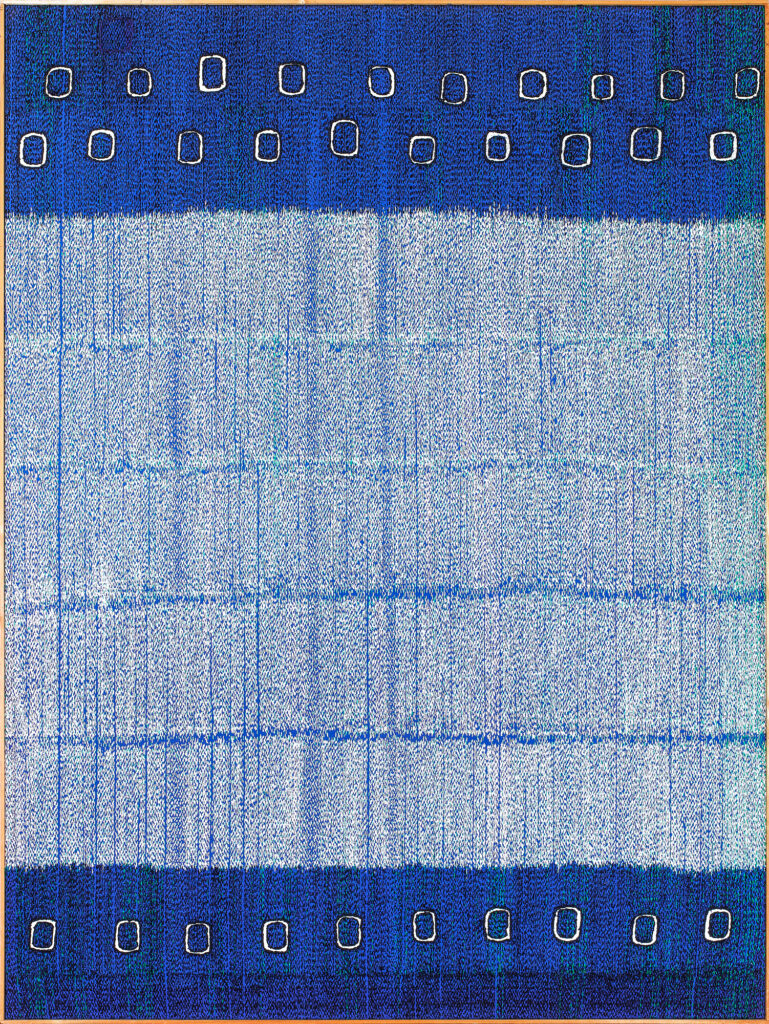
250 × 183 cm
What makes Chiyu Uemae’s paintings so compelling? They are not necessarily graceful in form; if anything, they tend to be rugged, with a strong sense of the hand at work. And yet, viewers are invariably drawn into the works.
Take his Nui (Stitched Works), for example. First, we are overwhelmed by the countless fine lines that spread across the surface. Then, our thoughts turn to the immense amount of time that went into making them. Finally, in our imagination, we come face to face with Chiyu Uemae himself, relentlessly repeating the same painstaking process, driven by an almost obsessive determination to bring the work to completion.
Indeed, Uemae as a person was very much like the works he created. Ask him a question, and his reply would often come in fragments, leaving you puzzling over how to interpret it. Yet, when it came to something he felt compelled to say, he would launch into it with sudden, fierce energy, sometimes catching you completely off guard. While quiet and unassuming, and a man of few words, he was nevertheless remarkably direct—expressing his own views and preferences to those around him with unvarnished clarity.
This same aspect of Uemae’s character can be seen beyond his art as well. During his lifetime, he self-published several books about his own path, his tensions with fellow members of Gutai, and his unique views on art. These books also contain numerous portraits of Uemae, many of them taken with a self-timer. Yet anyone who ever visited his studio would know that these writings and photographs were merely the tip of the iceberg. Day after day, Uemae generated an enormous volume of notes and photographs. For Uemae, making art, reflecting, and taking photographs were ways of continually affirming his own existence—and exhibitions and publications were the tangible proof of that existence.
Throughout his life, Uemae continued to question the meaning and value of his own existence. Behind this lay a struggle with poverty and a deep-seated sense of inferiority. To overcome these struggles and survive, he needed art. He needed painting.
Those who are drawn to Uemae’s Nui works have surely been moved, in one way or another, by the unwavering sense of purpose and purity that run through them, and by the dense energy that saturates their surfaces.
Perhaps this is because Uemae’s art carries a deeply universal theme: the very act of living. For this reason, his work takes on greater depth as our own lives deepen with experience. And I, too, have finally reached an age when Uemae’s Nui works resonate with me on a deeper, more personal level.