
Chiyu Uemae (1920–2018)
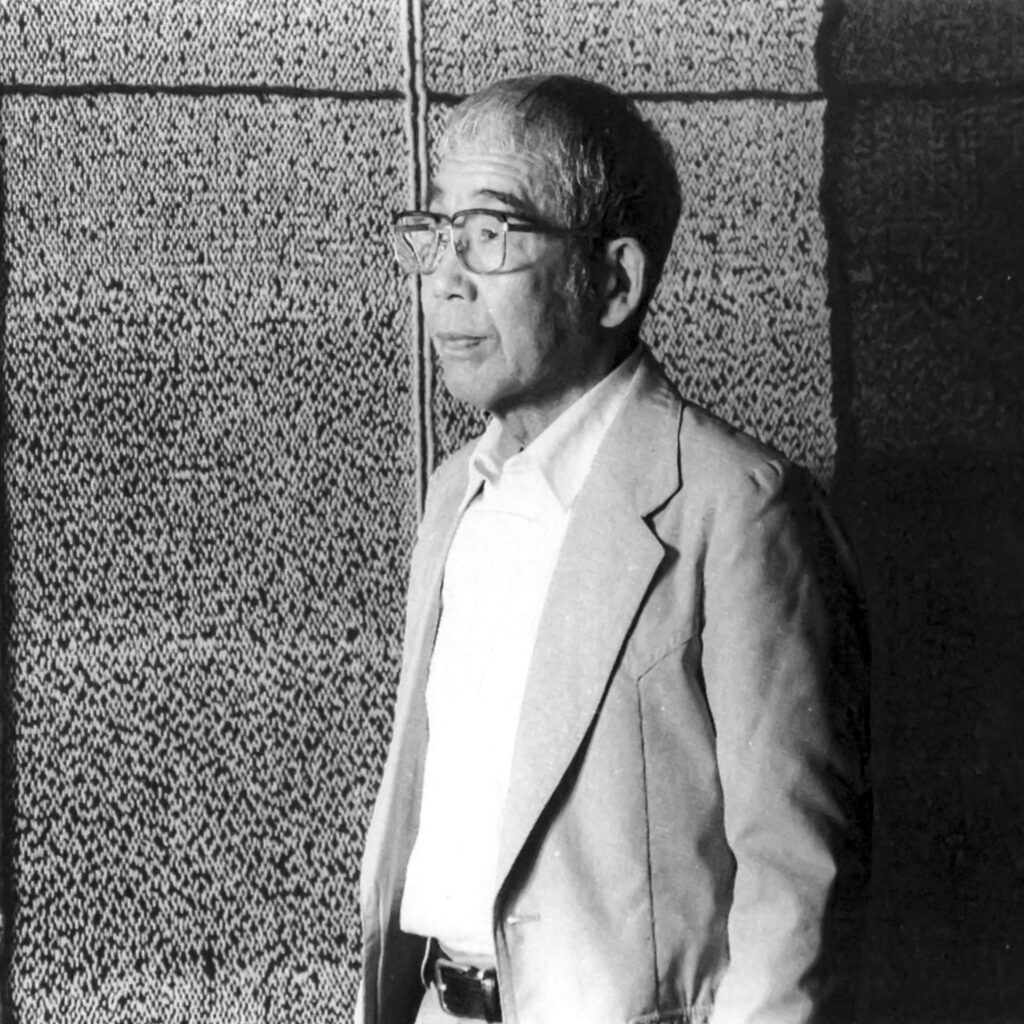
Chiyu Uemae was born in 1920 in Okuono Village, Naka District, Kyoto Prefecture (now part of Kyotango City, Japan). He was a founding member of the Gutai Art Association and remained active in the group from its establishment in 1954 until its dissolution in 1972. Within this pioneering avant-garde collective, Uemae developed a distinctive artistic practice in the broader context of postwar Japanese abstraction.
Although Gutai became internationally recognized for its radical “action-based” art, Uemae pursued a highly personal form of non-representational expression rooted in the meticulous accumulation of materials through repetitive handwork. His unwavering artistic vision and singular approach earned the admiration of critics, curators, and collectors alike.
At the 1958 exhibition The International Art of a New Era: Informel and Gutai, held at Takashimaya Department Store in Namba, Osaka, the influential French critic Michel Tapié—who played a major role in introducing postwar avant-garde art to the international stage—identified Uemae’s oil painting as one of the exhibition’s most remarkable works.
In 2012, Uemae was featured as one of the key Gutai artists in Destroy the Picture: Painting the Void, 1949–1962 at the Museum of Contemporary Art, Los Angeles, a landmark exhibition that reconsidered the history and possibilities of postwar painting.
Alongside his activities with Gutai, Uemae also exhibited in the Modern Art Exhibition (1954–1971), the Artist Union (AU, 1975–1983), and the Ge Exhibition (1976–2002), continuing to present his work consistently throughout his career.
Despite enduring loneliness, poverty, and hardship throughout his childhood and adolescence, Uemae remained steadfast in his determination to become a painter. In a diary entry written at the age of twenty-seven, he stated: “I must work in order to eat. Yet my life is sustained by painting.”
While supporting a family of five through physically demanding work as a crane operator at a blast furnace, he continued to dedicate himself tirelessly to his artistic practice. He spent nearly every spare moment before and after work painting, leading fellow artists to remark, “Uemae never sleeps.”
Such extraordinary perseverance and strength of will are reflected throughout Uemae’s life, including in his decision to clear forest land by hand and build his own studio. The resilience of a laborer and the passion of an artist existed inseparably within him, forming the foundation of his artistic identity.
During his years with Gutai, Uemae explored a wide range of approaches centered on the materiality of painting. These included oil paintings constructed from densely layered “dots,” incised “line” paintings created with a palette knife, and mixed-media works incorporating materials such as sawdust, matchsticks, and paint caps directly into the pictorial surface.
These works resonate strongly with a phrase often associated with the spirit of Gutai: “In Gutai art, the human spirit and matter shake hands while keeping their distance.”
Following the dissolution of Gutai, Uemae expanded his practice into new forms, including the NUI (stitch work) series using fabric and thread, wooden assemblages, ink drawings and prints, and oil and mixed-media works centered on the motif of the square. His exploration of non-representational expression continued with remarkable vitality throughout his life, even into his nineties.
In 1999, Uemae received the Medal with Dark Blue Ribbon, a Japanese national honor awarded for contributions to the public good, as well as the Hyogo Prefecture Cultural Award. He passed away in 2018 at the age of 97.