
Captivated by the Prints of Chiyu Uemae
Yoshitaro Sakaue
Honorary Advisor, BB Plaza Museum of Art
“Within my mind, a strong sense of inferiority and an equally firm sense of superiority fluctuate like atmospheric pressure. From my brain, shaped by a lifetime of experience, something like a fermenting enzyme stirs, and images—perhaps they should be called ideas—bubble up one after another. And these ten fingers, trained to be more versatile than any computer, engrave the images transmitted from the brain through the nerves onto chosen materials. What is inscribed in this way is no longer mere matter; it is an eternal and indestructible image of myself—a gravestone infused with the very breath of the artist (myself) at that moment.”
— Chiyu Uemae, Contemporary Art: My Case (1988)
As this passage suggests, Chiyu Uemae was a sincere and dedicated artist who continued to produce works over a long period, encompassing painting, sculpture, printmaking, and his “NUI” (stitched) works using thread and cloth.
Born in Kyoto Prefecture in 1920, Uemae initially taught himself Nanga (literati painting) before the war, later turned to Western-style oil painting, and eventually studied under Jiro Yoshihara after the war. In 1954, he became a founding member of the Gutai Art Association, the renowned avant-garde artist collective, and in 1962 became a member of the Modern Art Association. He was an extraordinary artist who remained active internationally well into his nineties.
Alongside his artistic practice, Uemae authored several self-published books, including Jumping Knife (1976). In these writings, he reflects in detail on his involvement with the Gutai Art Association, his personal upbringing, his transition from Kawasaki Heavy Industries to Kobe Steel, his fellow painters, and the struggles of his creative process. Collectively, these publications form a valuable record of his life as an artist.
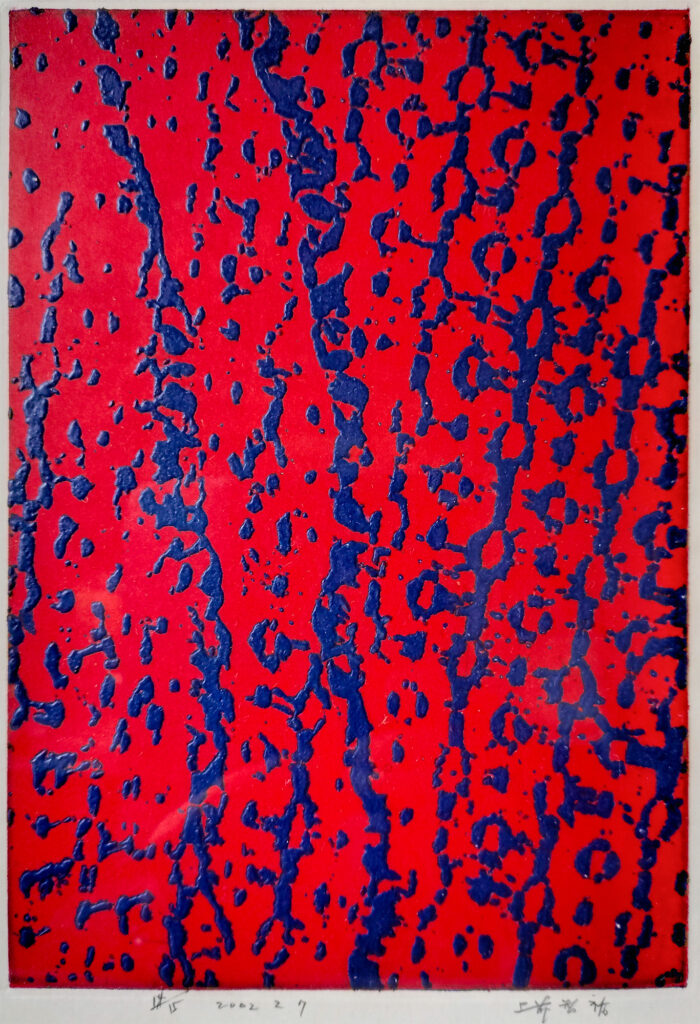
In 2002, I purchased a print at Chiyu Uemae’s solo exhibition held at Gallery Circus Circus, which was then located in Kobe. It was a color etching that immediately captivated me (fig.). Uemae had long worked in Kobe as a crane operator while continuing his artistic practice. Reflecting on those days, he described his workplace as his “Zokei Daigaku”—his own “university of form”—and wrote as follows:
“…I began working as a crane operator at Kobe Steel, through its subcontractor, Shimabun. As it turned out, the entire premises of the steelworks were like a ‘magical city.’ The various activities and structures within and around the plant formed scenes of a strangely compelling, almost sculptural beauty. Though I saw it every day, I found myself continually seized by new aesthetic impressions, one after another.”
— Chiyu Uemae, Memories: At Nadahama, Kobe (2010)
Just as this recollection suggests, the etching I own (dated 2002) evokes the surging flow of molten iron. It is an original work that also fascinates me with its painterly matière, reminiscent of an oil painting. Perhaps, perched high in his crane, Uemae sought to transform those industrial patterns into a concrete, artistic form.
Uemae’s prints sometimes take the form of multi-block compositions, where the addition of various colors produces unexpected effects through their layering, creating a rich diversity of expressions. He later recalled that his engagement with printmaking began around 1980, when he produced several thousand ink drawings (bokuga) as part of his intensive study of non-figurative art.
Regrettably, Chiyu Uemae passed away in 2018 at the age of ninety-seven. I would like to conclude this essay by sharing a poem of his that has remained unforgettable to me.
Even if tomorrow the earth is destroyed by nuclear blast,
With a sweat-stained towel around my neck,
Without a shred of shame,
Like a road worker facing eternity,
No one shall extinguish this burning fire within.
Though the flesh may wander in any way it will,
Exposing its wretched state and rotting away,
What remains here—
The path I carved out alone,
I have traced with a single stroke.
— Chiyu Uemae, Jigado: The Way of My Painting (1985)